Lightning: The Final Frontier?

Lightning News?
Most people think control looks like laws, borders, or surveillance, but the deeper layer is simpler and far more pervasive: money. That’s because because money quietly determines how people spend their time. That is far more effective than any written law.
“Give me control of a nation’s money and I care not who makes its laws.”
— often attributed to Mayer Amschel Rothschild
The Hidden Layer of Control
When people hear terms like
- taxation
- monetary policy
- quantitative easing
…it sounds distant and technical, something handled by experts somewhere else. But strip it down, and it becomes very real: People don’t wake up and ask, “What do I truly want to do today?” They ask:
“What do I have to do to get paid?”
That single question determines:
- where they go
- what they build
- who they serve
- how they spend most of their waking lives
If you can influence how people get paid, you can influence what they spend their lives doing. You don’t need to control people directly. Their incentives do it for you.
Control Without Visibility
This is why money matters more than laws. Laws are visible; money is structural. Laws tell you what you can’t do; money shapes what you must do. In modern systems, control over money doesn’t just come from taxation. It comes from:
- the ability to expand supply
- to create credit
- to defer consequences
- to obscure where value is really flowing
It’s like giving a gambler an ever-increasing line of credit. Losses don’t have to be settled immediately—they can be pushed into the future, redistributed, or hidden entirely. The system keeps running but the cost is paid—just not by the same people who made the decisions.
The House Always Wins: Fiat vs Bitcoin
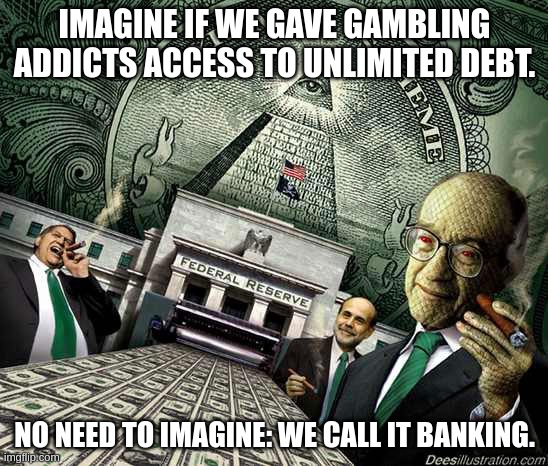
It’s often said that in a casino, the house always wins. Not because every player loses immediately, but because the system is designed with an edge that plays out over time. Our current monetary systems share a similar dynamic. The advantage isn’t always obvious, and not everyone loses at once—but those closest to the source of money creation tend to benefit first and most. The game can be played and even won for a while—but the structure itself isn’t neutral.
With the Lightning Network (and Bitcoin beneath it), the shift is clear: there is no central “house” setting odds. Rules are transparent and fixed, and you bear your own risk directly. The risk doesn’t disappear—but it becomes honest. For the first time in a long time (perhaps ever), the game isn’t tilted by an invisible house.
[Note: In reality, even the house doesn’t win in the end… but that would spoil the flow of the article so I won’t mention it….]
It’s Not About Good People
A common response to broken systems is that “we need better leaders.” But systems don’t fail because people are uniquely bad; they fail because incentives allow bad behavior to scale. Even well-intentioned actors respond to the environment they’re in.
In The Good, the Bad and the Ugly, none of the characters are purely “good”; they’re opportunistic and self-interested people, navigating a harsh landscape. What matters isn’t their morality—it’s the structure they operate within:
- what’s possible
- what’s rewarded
- what’s constrained
The outcome emerges from the system, not the virtue of the players.
A Different Kind of Frontier
New frontiers are always messy. They’re:
- uncertain
- risky
- full of failure and experimentation
But they’re also:
- open
- permissionless
- full of possibility
That’s where the Lightning Network sits today. It’s not polished; it’s not risk-free and it’s still being built in real time. But it does introduce something fundamentally different:
- value transfer without permission
- direct peer-to-peer exchange
- no central authority controlling issuance
And most importantly:
- no easy way to expand the system invisibly
Risk as a Feature, Not a Bug
We’ve been trained to see risk as a flaw. If something isn’t safe, smooth, and guaranteed, we avoid it. But in open systems, risk often plays a different role. It:
- forces responsibility
- prevents blind trust
- makes large-scale control harder to establish
If there were no risk, the system would already be controlled. The very thing people want removed is often the thing keeping the system open. As Benjamin Franklin said, “They that can give up essential liberty to obtain a little temporary safety deserve neither liberty nor safety.”
What Changes When Money Changes
If money shapes behavior, then changing money changes outcomes. It doesn’t try to make people become better; rather, it shapes our behavior without trying to change our nature.
In a system like bitcoin, where:
- supply can’t be easily expanded
- costs can’t be endlessly deferred
- transactions don’t require permission
…the ability to exert large-scale control is reduced. Not eliminated, but constrained. And that matters because control systems are expensive; they require infrastructure, enforcement, and coordination.
If a network is:
- cheap to operate
- decentralised
- and doesn’t concentrate power easily
…it becomes harder to capture in the traditional sense.
The Final Frontier?
Every previous frontier—land, resources, even information—has ultimately been shaped by monetary incentives. Change the money, and you change the foundation those systems rest on. So maybe this isn’t just another frontier; maybe it’s the one that sits beneath all the others. Not the last technological frontier… but the last necessary one for control.
One thing that sets many anarchists apart from other revolutionaries is the belief that the revolution is not a grand apocalyptic moment that we must wait for. The revolution exists in every moment of our lives. When I get up in the morning and spend my day deliberately doing things that please me, when I strive to live instead of merely existing, that is the revolution happening.
– Forest Life – by Monkey
Freedom isn’t just about what you’re allowed to say or own; it’s about what you’re able to spend your life doing. And for a long time, that has been shaped—quietly and pervasively—by money. If that layer changes, everything above it begins to shift, maybe slowly, maybe unevenly, but fundamentally.