DIY Adjustable Infrared Lamp Therapy Stand
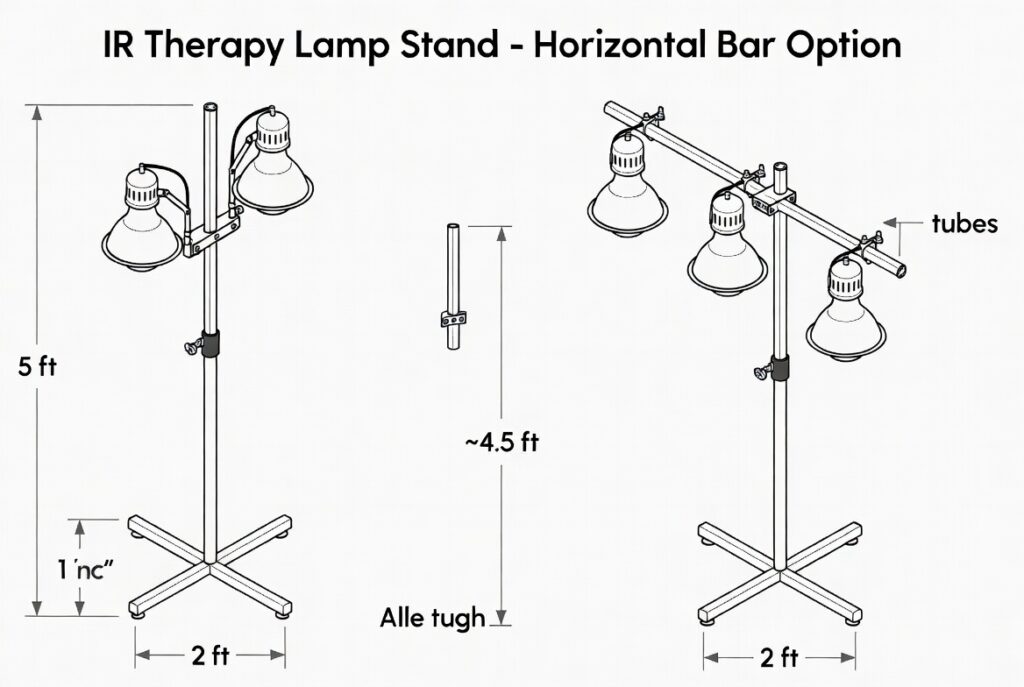
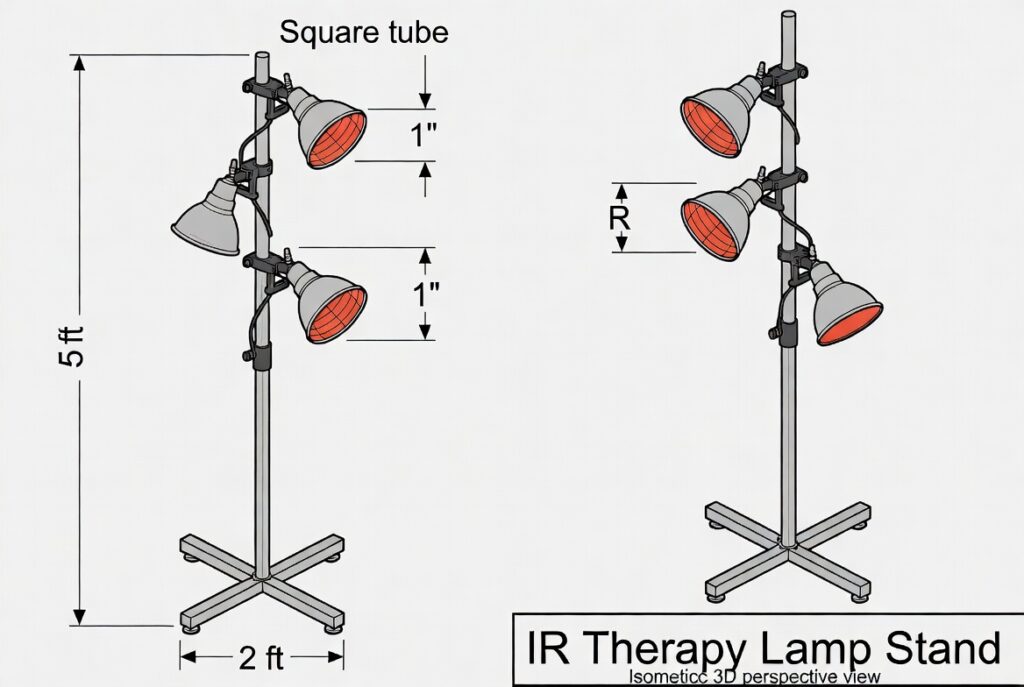
Project Overview Building a therapy stand for 3 × 300W (~900W total) infrared heat lamps. The design uses a metal frame for safety and heat resistance (wood is not recommended due to fire risk). The stand features a tall upright pole with adjustable lamp positioning for targeted therapy.
Design Options
1. Vertical Pole Version
- Main upright: 5 ft (≈1.5 m) tall, 1″ (25 mm) square steel tubing.
- Base: Cross or H-shape with legs extending ≈2 ft (60 cm) on each side for stability (optionally with locking casters).
- Three heavy-duty adjustable clamps on the upright pole allow independent height and angle adjustment for each round PAR/R-style 300W IR incandescent bulb.
2. Horizontal Crossbar Version (optional, for broader coverage)
- Same base and upright as above.
- Add a wider horizontal crossbar (≈4–4.5 ft / 1.2–1.4 m long, 1″ square tube) mounted near the top of the upright.
- Mount the three lamps along the horizontal bar for side-by-side arrangement (ideal for full-body areas while lying down).
- The crossbar can be made removable (clamped or bolted) to switch between configurations.
Materials
- 1″ square steel tubing (1/16″ or 1/8″ wall thickness recommended).
- Heavy-duty square tube clamps or custom-welded brackets for lamp holders.
- Porcelain sockets and metal reflectors rated for 300W+.
- High-temperature wiring and proper grounding.
Power Control Use a high-power Variac (variable autotransformer) for clean analog voltage control, or a heavy-duty incandescent-rated dimmer (1000W+). Rheostats are inefficient and generate excessive heat.
Safety Notes
- Metal construction is essential due to high heat output.
- Ensure wide stable base to prevent tipping.
- Use heat-resistant components and maintain safe distance from skin (typically 12–24″).
- Add timer, thermal protection, and proper fusing.
- Ground all metal parts.
Bulb Availability
Classic 300W incandescent IR heat lamps (round PAR or reflector style) are likely to remain available long-term. They are widely used in restaurant food warming, agriculture (brooders), and therapy. Stock spares and source from restaurant supply, farm, or online specialty bulb retailers. Energy efficiency regulations mainly target general lighting, not these specialty heat lamps.
Construction Tips
- Welding provides the strongest joints for the base and crossbar.
- Bolted or clamp-style assembly is possible if welding is unavailable.
- Clamps with tool-free knobs are ideal for easy adjustment.
- Paint or powder-coat for corrosion resistance.
This modular design is straightforward for a welder/fabricator to build from the orthographic + isometric sketches.
Dimmer Switch
Modern dimmer switches (triac-based) work by rapidly switching the AC power on and off — this is called phase-angle control or “chopping” the waveform. It’s efficient and doesn’t waste much power as heat in the dimmer itself, but it can cause issues like buzzing/humming in some loads, RF interference, or uneven heating in certain heaters/lamps. For resistive loads like infrared (IR) heat lamps (which are basically high-power incandescent-style bulbs), standard incandescent-rated dimmers often work reasonably well, but they’re not perfectly “clean” sine-wave output.
Rheostat Option
A rheostat is a variable resistor — exactly the old-school analog way you remember. It reduces current/voltage to the lamps by converting excess power into heat in the rheostat itself.
- Pros: True analog control, smooth, no switching noise.
- Cons: Very inefficient for 900W. At half power, you’d dissipate ~450W as heat in the rheostat — it would get extremely hot, need massive heatsinking/fan cooling, and waste a lot of electricity. High-power rheostats for this wattage are bulky, expensive, and not practical for a therapy lamp build.
They’re rarely recommended for anything over a few hundred watts today unless it’s a very low-duty application.
Better Alternatives for Analog-ish Control
For your wooden IR therapy lamp (3 × ~300W lamps = ~900W total), here are practical options:
- Variac (Variable Autotransformer) — Best “analog” solution This is the modern successor to the rheostat idea. It adjusts the output voltage smoothly via a transformer winding (no chopping, clean sine wave).
- Very efficient (little wasted heat).
- Excellent for heaters/lamps.
- You can find 1000VA+ models that handle 900W easily.
- Downside: Bulkier and more expensive than a simple dimmer (~$50–150 depending on size/quality). Many people use them for precisely this kind of project (heat lamps, kilns, etc.).
- High-Power Incandescent/Halogen-Rated Wall or Inline Dimmer Look for ones explicitly rated for resistive loads and at least 1000W+. Many still work fine with IR lamps. Test compatibility — some lamps handle phase control without issue.
- PWM Controller (for DC, if you convert) If you’re open to it, rectify the AC to DC and use a high-current DC PWM dimmer. But this might be overkill and introduces its own switching (though at higher frequencies, often less audible).
Recommendations for Your Build
- Safest/easiest starting point: Try a heavy-duty triac dimmer rated for incandescent loads (1000W+). Many users successfully dim IR heat lamps this way.
- For true clean analog control: Go with a Variac. It’s the closest practical equivalent to an old rheostat without the massive heat waste.
- Safety notes (critical for a wooden enclosure + high power):
- Use proper high-temperature wiring and lamp sockets.
- Add thermal protection (thermostat or cutoff).
- Ensure good ventilation — IR lamps get very hot.
- Mount the dimmer/Variac externally or with excellent heat management.
- Consider fusing and grounding.