Provably Fair
Cryptographic Fairness at Scale
The “provably fair” protocol itself doesn’t become invalid at scale — it’s just a deterministic calculation:
- Each ticket can be represented as a number (or seed) derived from server seed + client seed + ticket index/nonce.
- The draw calculation is just hashing or RNG computation for each ticket.
- Verifying fairness is the same whether there are 10 tickets or 10 million.
So cryptographic viability technically works at any scale.
Practical Concerns
Where it might get tricky is performance and storage:
- Server Load
- If you literally compute a hash per ticket for millions of tickets at draw time, it can be expensive. But cryptographic hash functions like SHA256 are very fast; even a million hashes is trivial for a modern server.
- Auditability
- Publishing a separate hash per ticket could be messy.
- A common solution: treat the entire ticket pool as one batch, and calculate winners via deterministic RNG rather than hashing each ticket individually.
- Client Interaction
- If every player is supposed to verify every single ticket, that could be cumbersome.
- Usually, you just provide enough information to verify the winning ticket(s) without exposing all tickets individually.
Common Scaling Approach
For lotto faucets or big-ticket pools, operators usually do something like:
- Server seed + master hash: Pre-commit to a master RNG seed before the drawing period.
- Ticket IDs: Each ticket gets a deterministic number derived from master seed + ticket ID.
- Draw: Calculate the winning number(s) by a deterministic formula from the master seed (and optional client seed) without having to hash every single ticket.
- Publish proof: Show the master seed + ticket algorithm so players can verify the winning number was fair.
- This way, even if you have millions of tickets, players can verify the draw without checking every single ticket individually.
Summary
- Provably fair at small ticket value: Fully feasible.
- Millions of tickets: Still feasible, but you need to batch or deterministically calculate winners rather than compute and publish millions of hashes.
- Server-side load: Not a big problem; hash functions are fast, and only the draw calculation matters, not ticket creation.
Bottom line:
For a lotto faucet like you’re describing, a provably fair system can scale if you design it to verify winners, not every single ticket, using deterministic RNG from a pre-committed server seed. It won’t be prohibitively expensive or slow, even with very small-value tickets.
Summary of Provably Fair Systems for a Lotto Faucet
- Provably Fair Basics
- A server pre-commits to a secret server seed by publishing its hash.
- Players optionally provide a client seed.
- A nonce (ticket index) ensures unique outcomes per ticket.
- After the draw, the server reveals the seed. Players can verify the result matches the original hash.
- Applicability to Lotto Faucets
- Even if tickets are very low value (e.g., 0.0003 c each), provably fair systems work.
- The system ensures the draw is transparent and tamper-proof, regardless of ticket value.
- Scaling Considerations
- Millions of tickets are feasible because:
- Hashing and RNG are fast for modern servers.
- You don’t need to store or hash each ticket individually; you can derive tickets from a deterministic formula.
- Verification can focus on winning tickets, rather than every ticket issued.
- Pre-committing to a master seed and deterministic winner selection avoids server manipulation.
- Millions of tickets are feasible because:
- Recommended Approach
- Treat all tickets as a batch derived from a master seed.
- Each ticket has a deterministic value based on
master seed + ticket ID (+ optional client seed). - Winning tickets are selected using a deterministic formula.
- Publish the server seed and algorithm after the draw so players can verify fairness.
Conclusion: Provably fair systems are fully compatible with lotto faucets, including ones with millions of tiny tickets. The key is batching, deterministic generation, and publishing proof after the draw.
Practical Architecture for LottoFaucet.com
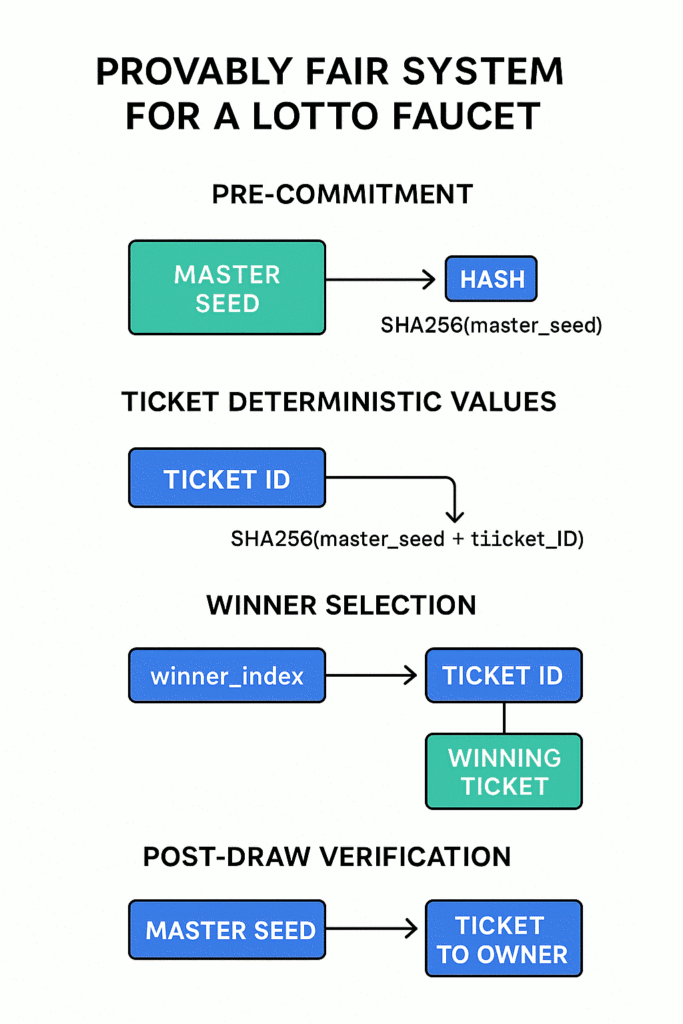
Here’s a step-by-step design that scales well:
1. Ticket Issuing
- Every user action that earns a ticket generates a unique ticket ID.
- Ticket IDs are just sequential numbers or hashes (
ticket_1,ticket_2, …). - Store ticket ownership in your database.
2. Pre-Commitment
- Generate a master server seed (long random string) for the current draw period.
- Compute its hash (
SHA256(master_seed)). - Publish the hash before tickets are issued. This locks the server choice.
3. Ticket Deterministic Values
- For each ticket:
ticket_value = SHA256(master_seed + ticket_ID [+ optional client_seed]) - This generates a deterministic “random number” for each ticket without storing extra info.
4. Winner Selection
- Decide the number of winners or the winning amount.
- Use a deterministic formula, e.g.:
winner_index = ticket_value % total_tickets - Can also do multiple draws using additional hashing:
winner_2 = SHA256(master_seed + "draw2") % total_tickets
5. Post-Draw Verification
- Publish the master seed and the ticket-to-owner mapping.
- Players can verify that their ticket(s) were calculated correctly from the seed and check if they won.
6. Optional Enhancements
- Let users supply a client seed to make manipulation even harder.
- Maintain a public ledger of hashes for transparency.
- Batch winner verification to avoid overwhelming players.
Key Advantages
- Works for millions of tickets.
- No need to hash/store every ticket individually.
- Transparent and auditable by anyone.
- Scales efficiently for very small-value tickets.